
Crossing the Pond: The Rise and Fall of the Transatlantic Ocean Liner
A summary of the talk given by Stewart Raine on April 21, 2026
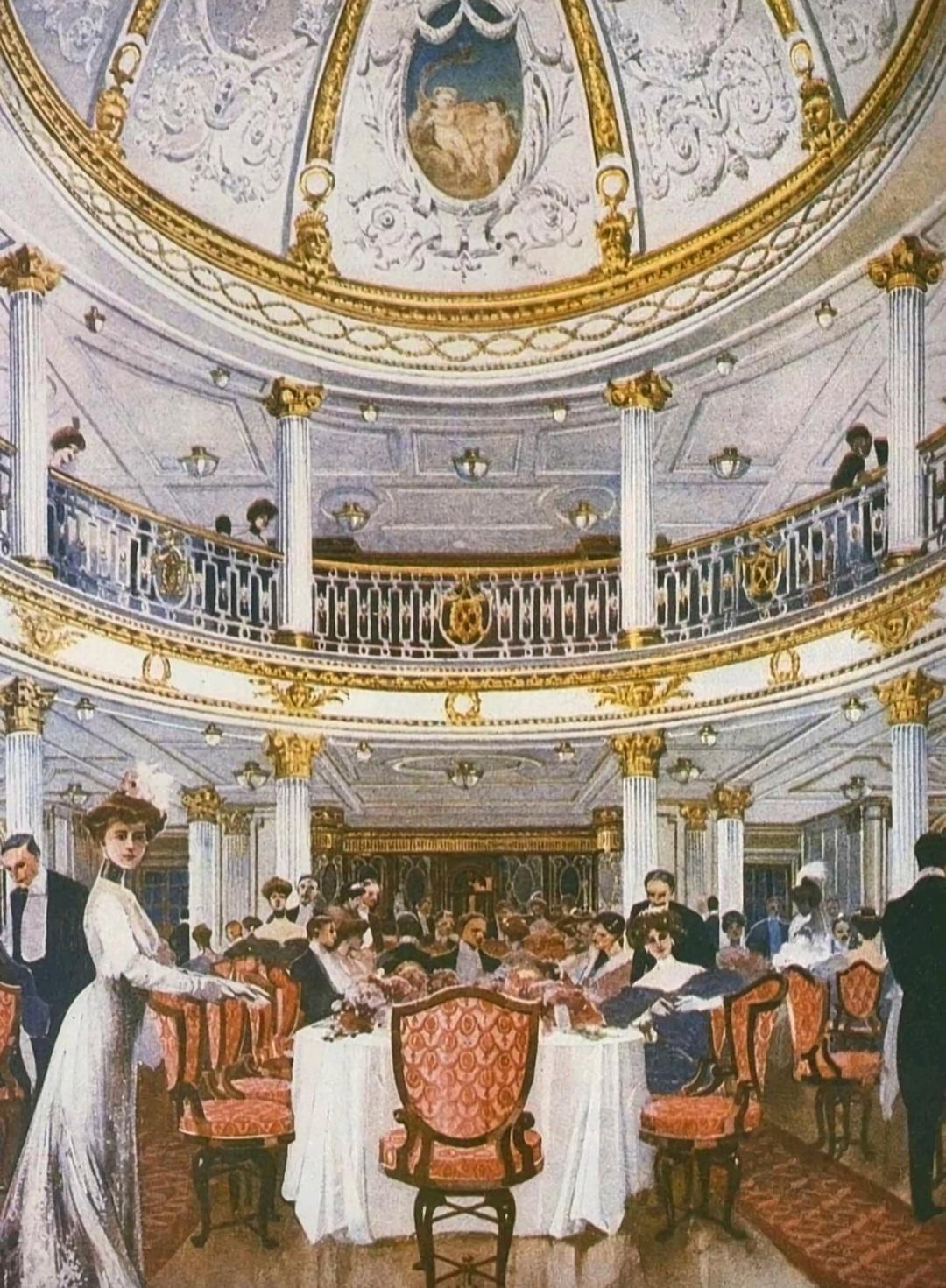
The phrase "crossing the pond" has long been used for transatlantic travel. Bishop Joseph Hall referred to the oceans generally as "the great pond" as early as 1612.
What began as a hazardous and uncomfortable sailing ship passage of several weeks was gradually transformed by the influence of Victorian engineering. Where passage had been restricted to the intrepid few who needed to travel to the New World, it became a fashionable extension to 'the season' for the wealthy and at the other end of the scale, mass migration for those seeking a new life away from poverty. The story of transatlantic shipping is, on one hand, about steel and steam and at the same time a social observation about changes that brought a modern world.
Before 1817, ships crossed the Atlantic without set schedules and at the mercy of the weather. The Black Ball Line was a pioneer of regular, scheduled crossings. Now punctuality was possible and competition grew intense. By 1838, the steam revolution had truly arrived with the arrival in New York of two coal-burning vessels. SS Sirius limped into New York from Cork after an eighteen-day journey, rumoured to have fed its own wooden fixtures into the boilers when its coal reserves ran low. Just a day later, the SS Great Western followed, a ship that ironically proved faster. These crossings led to the contest for the "Blue Riband“ — the coveted award for the fastest westward crossing.
Engineering ambition sometimes ran ahead of common sense. Isambard Kingdom Brunel advanced maritime technology by changing from the giant paddle wheels of the Great Western to the first screw propeller on the Great Britain – a controversial innovation at the time. But his enormous SS Great Eastern, with its 418 crew, carried fewer than 40 passengers, which was never going to be a commercial success. Those early lessons were learned by others as shipping giants like Hamburg America, North German Lloyd, Cunard, and J.P. Morgan's White Star Line built ever-larger, multi-funnelled floating palaces.
The irony is that the golden age of ocean liners is remembered for its dazzling opulence, yet it was ultimately funded by the poorest passengers. First-class travellers on ships like the Titanic enjoyed suites that cost the equivalent of £100,000 and enjoyed art deco dining rooms, multiple orchestras, boxing matches, and dancing demonstrations while the far more numerous third-class steerage passengers paid most of the running costs. In 1892 alone, North German Lloyd transported 120,000 people to America, where passengers faced rigorous health checks and tuberculosis screenings at Ellis Island upon arrival. These magnificent ships were vessels of the American Dream, funded out of sight below by the modest savings of the desperate, while the wealthy danced above deck.
When the world was torn by the two World Wars, these fast and therefore relatively safe vessels proved their worth far beyond commercial enterprise. On one occasion, the legendary Queen Mary transported an astonishing 15,740 troops in a single uncomfortable but relatively quick crossing. After the Second World War, the advent of jet passenger travel turned 'Crossing the Pond' into more of a leisurely option to enjoy a seven-day mini-cruise.
///////




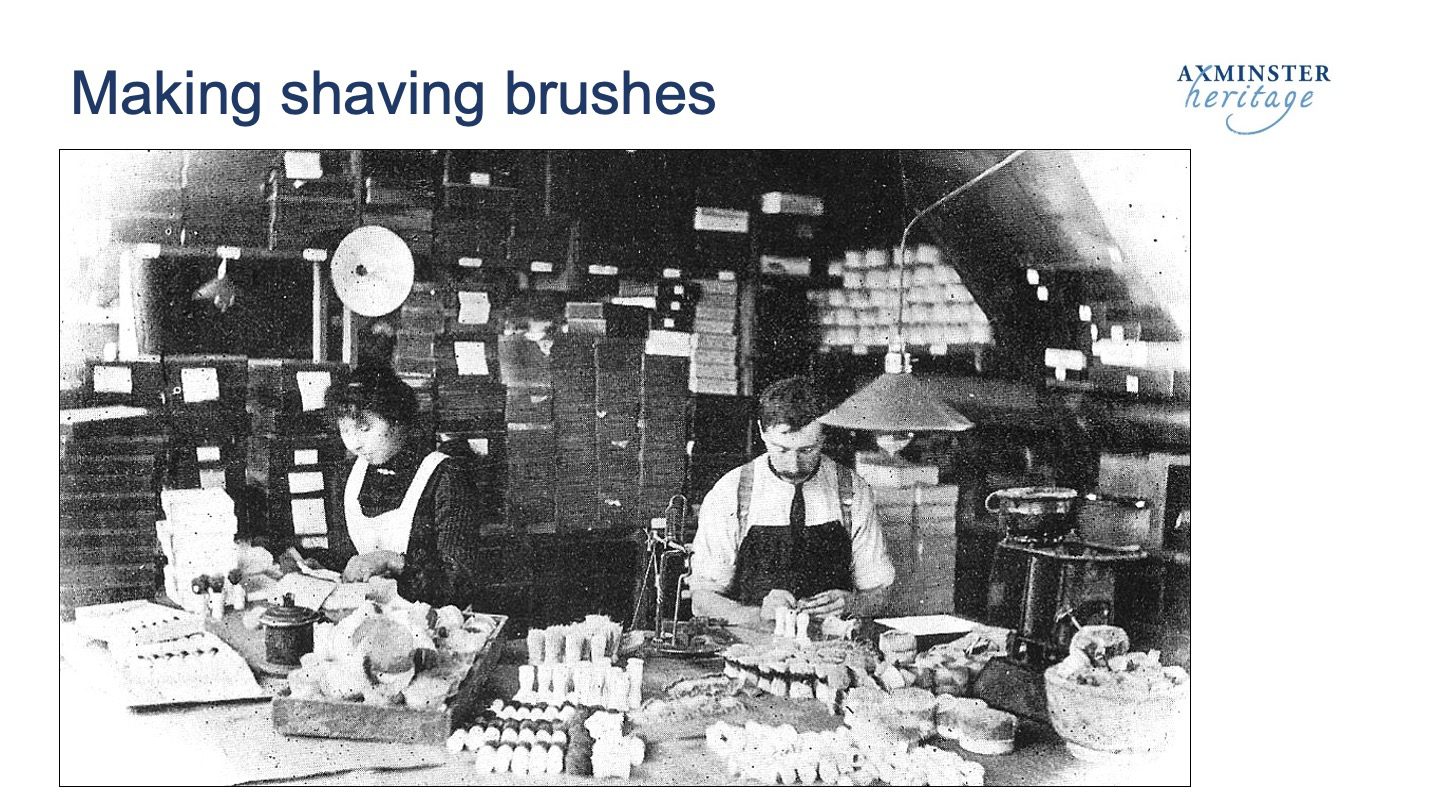
Water mills of the Otter and Axe find a new purpose
David Knapman reveals how former mills were turned to making a very Victorian invention: personal brushes for teeth, hair, and smart clothes.
///////
The history of brush making is largely about Axminster, which was a major centre for this industry, but the story also touches on Nimmer Mills, Chard – with the large Otter Mill also becoming the centre of a large but short-lived brush-making business.
The timeline spans the late Victorian period to the 1950s.
Two competing London brush manufacturers relocated their businesses to adjacent mills at the base of the steep Castle Hill leading down to a level crossing and the river. The key figures in this industry were James Coate, born in 1819 and deceased in 1907, and the Bidwell brothers, James and Arthur, who were about twenty years younger.
This local industry was to become a welcome employer in the town known for Samuel Whitty's carpet manufacturing business. George IV, a major purchaser of Whitty's hand-tufted Turkish style patterned carpets, died in 1830, and there were delays in recovering money owed, leading to the business ceasing in 1835 with significant unemployment.
However, there was expansion in the town, with improvements to the head weir and flow allowing more than one mill to operate.
Shortly after the London-Exeter railway reached Axminster in 1860, wool manufacturer James Boon relocated to Axminster. He took over the original town mill, and built a new mill right beside it, but after losing his wife, he retired and decided to lease the new mill. Here two former London brush-makers enters the Axminster story, James Coate becoming tenant of the new mill in 1882 while retaining his smaller Chard works. Also in 1882, a competitor, Bidwell Brothers, took the original town mill next door.
James Coate, grew up in Membury, just outside Axminster, and moved to London as a young man and established his first brush factory there in 1847. His innovative and patented method of securing bristles firmly to the brush handles brought him success, and needing more space, in 1864 he opened a second factory in Chard, and after a few years moved his main centre of production to his hometown of Axminster, bringing a significant portion of his workforce with him.
The second notable brush manufacturer in Axminster was the Bidwell Brothers business, established by their father in Hoxton, East London, in 1839. After his early death in 1850, his wife Susan managed to keep the business afloat. The brothers, born in the 1840s, grew up to take over the business and eventually moved it to Axminster in 1882.
The process of making brushes involved multiple steps and required precise skills, especially in securing the bristles. Both companies were vigilant in protecting their patents and regularly issued cease-and-desist letters to infringers. The industry was labour-intensive despite the mechanisation, providing employment opportunities for many, including significant homework for local women and children.
The toothbrush was a new idea to supplant the traditional use of a stick with a soft end to clean teeth. It required accurate drilling and cross-drilling into a hard material, and the middle bone from a bullock's leg, split into four, was ideal. It was a skilled task to pass a loop of wire through the drilling to draw a bundle of Siberian hog bristles through the holes. A refinement was a white enamelled finish which Bidwell's patented in 1872 – the forerunner of today's whiter-than-white disposables, and with a choice of 200 varieties and qualities, they sold widely through pharmacies across the UK for between 26 and 72 shillings per gross.
Hairbrushes – similarly the clothes brush – would be finished with a polished handle of rosewood imported from the West Indies. Both Coate’s and Bidwell's won large export orders, helped by the demands of armies and their uniforms in the American Civil War.
Where did Ottery enter this story? Its former wool and then silk mill was far larger than those in Axminster, and after eight successful years in Axminster, Bidwell Brothers saw opportunity in extending their business to Ottery. Additional shares were offered to local investors to provide funds for the expansion; business growth and dividend, unsurprisingly, was not immediate, and the investors became impatient. They employed a valuer who concluded that the business was worth less than its liabilities, and in February 1893, a liquidator was appointed.
The new owners, Keetch and Haworth, contested a very minor alleged discrepancy in the stock valuation and took the Bidwell brothers to court. When the case was heard locally, the brothers were found guilty, and sentenced to pay a modest fine.
There were appeals and a string of further hearings; it was not a happy ending, and eventually Keetch & Haworth faced their own bankruptcy hearing.
Brush-making in Ottery was a large enterprise and employer, but, sadly, one that only lasted a few years.
In their heyday, both Coate and Bidwell Brothers employed about 300 workers, including those who were outworkers.
The decline of brush making in Axminster was largely due to the advent of synthetic materials and especially the introduction of nylon in the 1950s, which replaced natural bristles and greatly simplified production. The remnants of the Bidwell business continued until closure in 1954.
It is a story that highlights the Victorian age of ingenuity and industrial mechanisation. It also brings out the social and economic impact of industry on small market towns like Ottery and Axminster and their surrounding areas, rising and falling with the fortunes of the major employers.
///////
A La Ronde – the story of a curious 16-sided house and its eccentric owners
From the talk given by Trevor Warrington on January 20, 2026. Additional details and photographs by Ian Greig.
The story starts with the construction of A La Ronde by two wealthy spinster cousins, Jane and Mary Parminter, who were second cousins, Mary being 17 years younger and having been a ward of Jane’s after her parents died young.
The house, a 16-sided building – technically a hexadecagon – was built in 1795 in the Marine Cottage Orné style, a fashionable architectural trend of the time. Another local example of this style is the Fairlynch Museum in Budleigh, built in 1810. You might expect a thatched roof with this style, and A La Ronde originally had this look.
Family tradition holds that Jane Parminter designed the house, inspired by the octagonal, domed Byzantine Church of San Vitale in Ravenna, Italy, which she and Mary visited during their seven-year Grand Tour. We don’t know who translated her vision into architectural drawings, but John Lowder, a young architect in Bath who was a distant relative, is a contender. Unfortunately, much information was lost during the bombing of Exeter city centre on the night of May 3-4, 1942, when much of the High Street and the County Records Office were destroyed.
The house was constructed from Beer stone and originally had few ground-floor windows, most of which were barred – forming a citadel basement area. This idea, strange to us, was of the time in 1795, following the French Revolution, the establishment of the First Republic, and the real threat of French invasion. .
Initially, the house had two floors and a storage area at the top, later developed into a shell gallery. The ground floor housed the kitchen and servants’ quarters, while the first floor contained the bedrooms and living rooms. By 1991, when the National Trust purchased La Ronde for £750,000, it required significant restoration before opening to the public.
Let’s meet the Parminters. In the house there’s a striking silhouette from 1783, before their grand tour, showing Jane with her family, her sister Elizabeth, engaged in craftwork with a pet red squirrel (grey squirrels hadn’t yet arrived in Britain), her brother-in-law, George, reading a book, and behind him is Jane’s brother John, playing the mandolin. Her sister Marianne is at the piano.
The Parminters were a wealthy family of North Devon merchants trading sugar from the Caribbean, tobacco from America, and more. Jane’s father, John, exported wine to Europe from Lisbon, where Jane was born in 1750.
A miniature of Mary Parminter, painted on ivory around 1784, shows her at the time she and Jane embarked on their Grand Tour.
The Grand Tour was a fashionable educational adventure for young gentlemen of the upper classes. Unusually for unmarried women, Jane and Mary undertook it in 1784. They travelled through France, Italy, Switzerland, and beyond, collecting curiosities and mementos, many of which are displayed in La Ronde’s Cabinet of Curiosities. They kept detailed journals – sadly, these were lost in the Exeter Blitz of May 3-4, 1942, which destroyed the High Street and Record Office.
One notable feature of A La Ronde is the shell gallery, which took the cousins more than a decade to create. It contains around 26,000 shells, mostly from British waters, arranged in intricate patterns. Visitors see the gallery through a virtual tour, as the narrow space is unsuitable for visitors.
The Parminters were active members of Lady Glenorchy’s Chapel, founded by the Scottish noblewoman as an Independent or Congregational church. Lady Nelson, who lived in Exmouth at this time for some years after her husband’s death, and shared the Parminters’ evangelical convictions, was known to have attended the chapel at times.
When in 1811 the two-mile journey (on foot—they wouldn’t call on the coachman on a Sunday) became too much for the cousins, they built their own chapel in the grounds, calling it Point-in-View. Jane passed away later that year, aged 61, and Mary continued to live at La Ronde until her death in 1849, aged 82. Both are buried at the chapel.
Mary’s will intended to preserve A La Ronde and its contents, nominating six unmarried kinswomen as heirs. However, by 1880, the property had passed to a distant relative, Reverend Oswald Reichell. He modernised it extensively, adding dormer windows, central heating, gas lighting, bathrooms, and indoor plumbing — bold innovations that probably saved the house from ruin. He lived there until 1923.
In 1991, La Ronde was acquired by the National Trust, ensuring its preservation. It remains a unique and fascinating property, well worth a visit.
///////
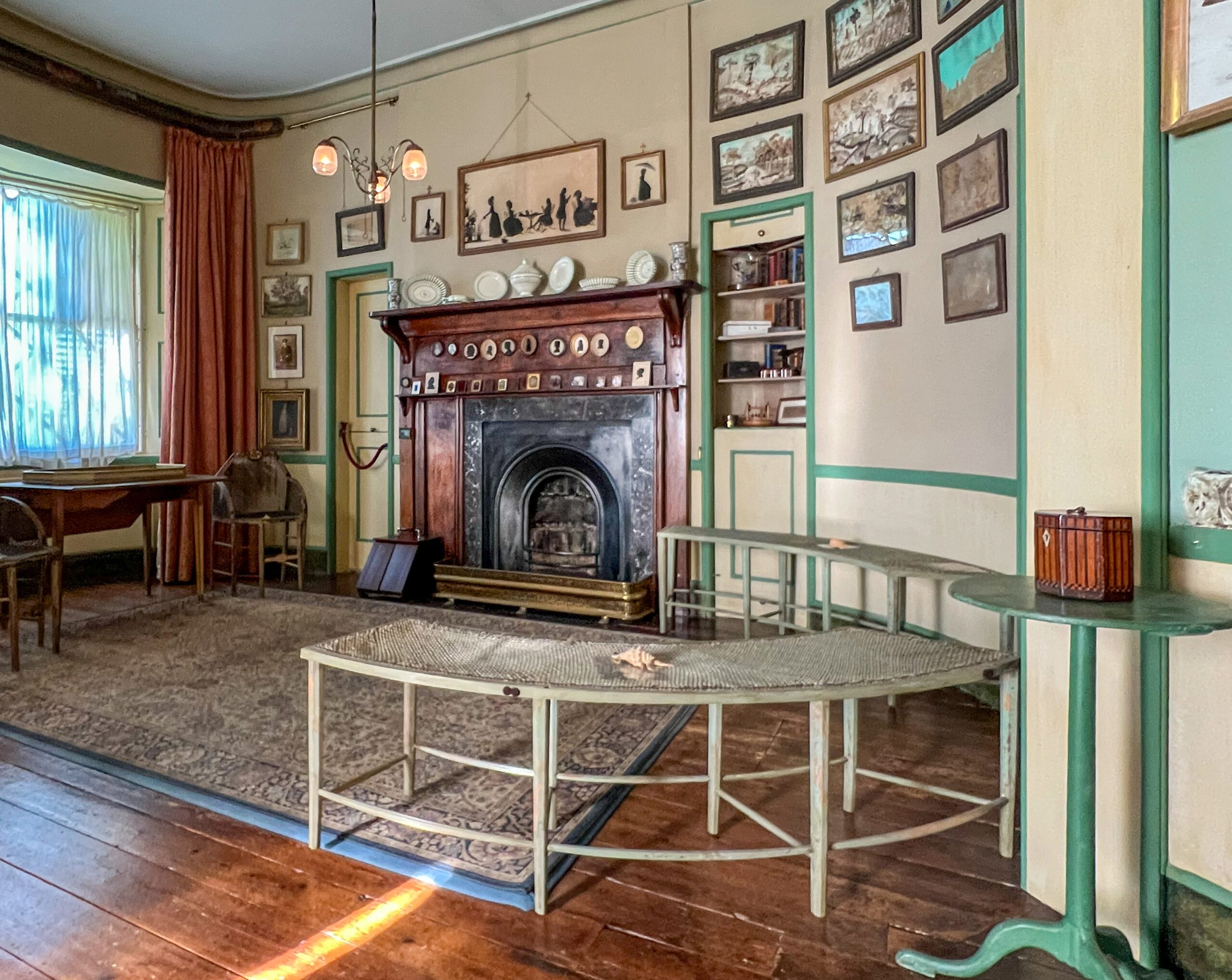
A La Ronde living room with gas mantle lamp, artworks and the silhouette of Jane Parminter and her siblings.

Frieze created by the Parminters from feathers and other natural materials.
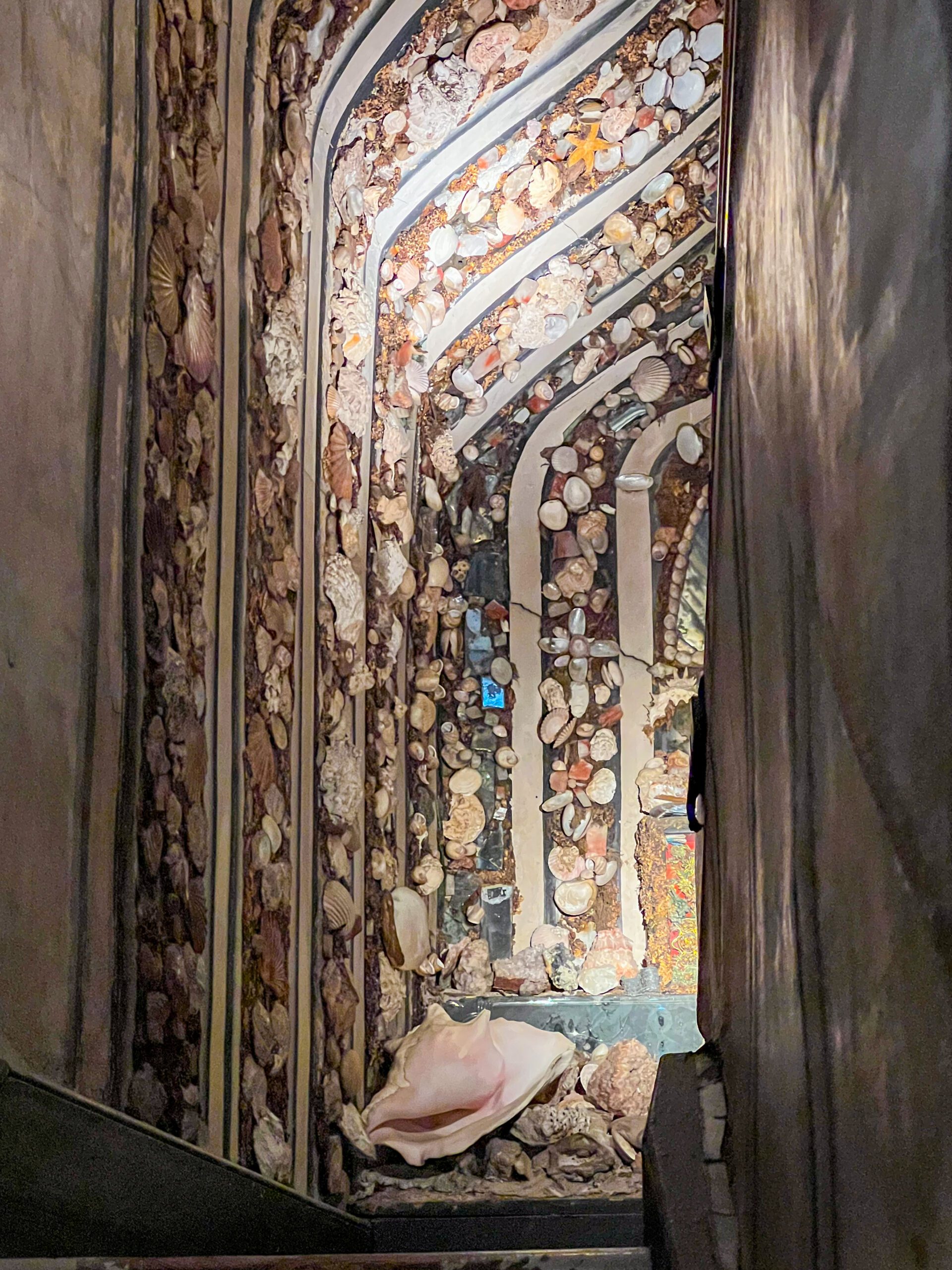
A view of the shell gallery in the cupola at the top of the building,

Innovative 'modern' plumbing including a bathroom and a form of central heating was added at the turn of the 20th century.
Devon's not-so-secret smuggling industry
On November 18, 2025, historian Robert Hesketh gave a talk about how Georgian Devon had been a renowned smuggling county
From the mid-1700s into the early 1800s, Britain was almost constantly at war. And funding war meant raising taxation – especially heavy duties of many times the value of imported "luxuries" like tea, coffee, silk, and spirits.
Smugglers left few written records, so most evidence is indirect: Customs files, court records, parliamentary inquiries. In 1785, George Bishop's report to Parliament claimed that as many as 60,000 people were involved.
While Bristol was the main centre for legal imports, Devon gained a reputation as a smuggling county – more opportunity than mystery: two long, indented coastlines with hidden landing places; plenty of sailors and boat builders; old links with the Channel Islands and northern France; communities living close to subsistence. Smuggling often felt less like crime and more like getting by.
Beer, Branscombe, and the Rolle family
In East Devon, the Beer Quarry Caves were ideal for concealment: around 75 acres of underground workings, well beyond easy reach of the authorities. Quarry life was hard – stone dressed underground by candlelight, wages precarious – so smuggling was a constant temptation.
The Rolle family were Lords of the Manor and philanthropists, yet Beer and nearby Branscombe were smuggling country. For those with money, it was like any other venture: you could buy "shares" in a run.
One of the best-known local figures was Jack Rattenbury, born in Beer in 1778. He went to sea aged nine, was smuggling by 16, and used the caves at Beer Head and the Quarry Caves to stash contraband. He became a folk hero for clever disguises and ingenious escapes, later telling his story in *Memoirs of a Smuggler*.
Seamanship, audacity, and community attitudes
Smugglers were often praised – sometimes grudgingly – for their seamanship and audacity. Even naval officers remarked on it, and sympathy ran high when the alternative was poverty.
Fishing was ideal cover. Brandy could be dropped overboard in roped-together barrels, then hauled up once the coast was clear. An estimated 50 smuggling vessels handled 17,000 barrels a year in Kingsand and Cawsand alone. Cornwall had the same advantages, making smuggling a regional pattern across the southwest.
Across the Channel, places like St Malo and Roscoff benefited from seaborne trade; making a port "free" could be a deliberate move that encouraged trafficking alongside legitimate business. Smuggling depended on fast, broad-beamed luggers, opposed by armed revenue cutters – though some cutter crews were suspected of collaboration.
Community protection was essential. Sympathetic juries made convictions hard, and gentry, even clergy, could be involved, with diaries suggesting little shame attached. Penalties could include losing vessel and cargo, and sometimes impressment into the Royal Navy.
Operations leaned on landscape and signals: Beer Head for smoke signals, church towers for watchkeeping, hiding places from churchyards to caves to the undercliffs, and landings at discreet spots like Dawlish Warren
But always the greatest danger remained the sea itself – the sombre message of the abandoned vessel reported to have been washed up on Hope Beach.
///////
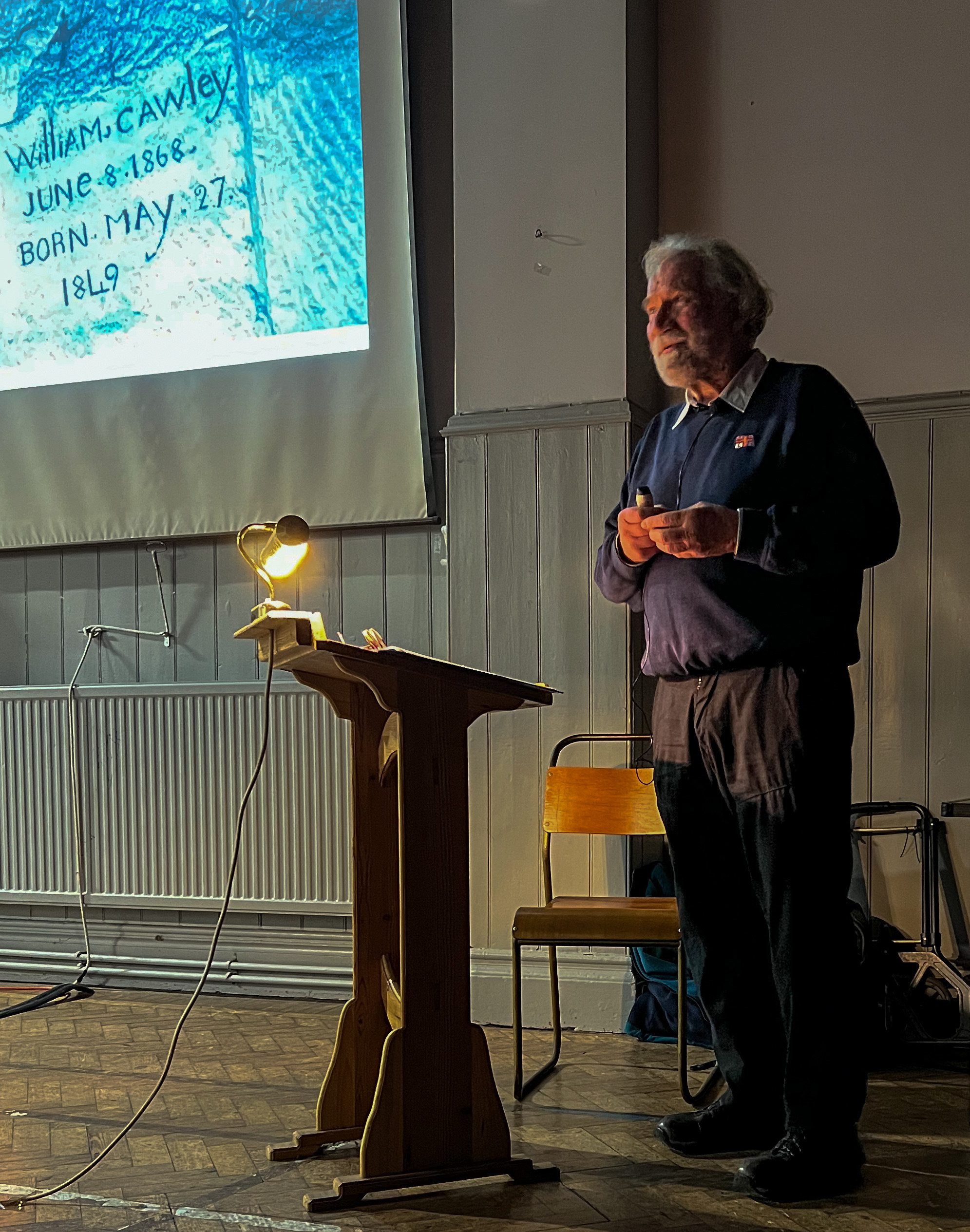
November 2025 speaker Robert Hesketh

Britain's secret defences – the story of Britain's Auxiliary Units
Civilian spies, saboteurs and assassins hiding in plain sight
This article is taken from the talk given by historian (and Kings School former student) Andrew Chatterton on October 25
IN the beginning, this initiative, which anticipated the start of the Second World War, was very ‘hush-hush’ – in the language of those times.
Originally conceived by Royal Engineers officer Laurence Grand, who at that time was heading the Secret Intelligence Service that became MI6, the plan to create civilian local Auxiliary Units was so secret that even MI5 and the military were unaware
By 1940, Grand had enlisted a thousand civilians, armed them, and provided them with explosives — a lot of explosives, as it happens.
Others shaped this secret defence corps, such as Andrew Thorne, a former military attaché in Berlin who had learned about German peasant militia. He approached Churchill, who was enthusiastic.
Peter Fleming, brother of the better-known Ian Fleming, began developing what became Auxiliary Units as the XII Observation Corps, and then Colonel Colin Gubbins, with a long history in irregular warfare in Russia, Poland, Ireland, and Norway, expanded the concept.
This was a resistance movement, but not as we know it. It was unlike the more familiar French Résistance, whose mission in occupied France was a long game of waiting for opportunities. By contrast, the Auxiliary Units were trained for short, sharp, violent, and potentially suicidal actions following an invasion.
Local patrols were concentrated in strategic coastal areas, like the former A35 trunk route in Devon and Dorset, which used to follow the present A3052. Patrol volunteers consisted of reserved occupation active people like market gardeners, farmers, gamekeepers, smallholders, bakers, and bricklayers, typically those living close to footpaths and with a countryman's intimate knowledge of the locality.
As an example, the Warsash patrol in Hampshire was made up of relatively young men, none of whom were fathers.
Operating under the strict limitations of the Official Secrets Act, more than three-quarters of these secret defence members lived out their lives without ever speaking about their wartime roles.
The first intelligence officer in Devon was J. W. Stuart Davidson, and the patrols in mostly coastal areas of the county that he had oversight of consisted of six to eight men led by a patrol leader sergeant chosen for their reliability and local expertise.
In an invasion scenario, these men would disappear into hiding as soon as the Germans appeared. There was no outside contact. Their role was not to engage in pitched battles but to select targets to cause maximum disruption to the supply chain.
It was not 'cricket' because there needed to be a brutal aspect to this work – they fought dirty. A list of names was prepared for elimination as soon as the Germans arrived. Some names could be people who, if captured and tortured, could jeopardise secrecy.
This meant that the window of opportunity would be very short, and typically only a fortnight’s rations were stored in the hidden underground base.
Weapons were provided: all men received Smith and Wesson revolvers and explosives. Auxiliary Units tested their booby traps and new devices in local quarries.
They were trained in unarmed combat and silent dispatch of sentries to create fear and hesitancy.
Operational bases
At first, the men dug the bases themselves, but it was slow work, raising the risk of being observed. Later, Royal Engineers tunnelling companies of two dozen were able to complete them within 72 hours. Most common was the 'elephant shelter' pattern with a long winding escape tunnel. The entrance hatch, counterbalanced and disguised with foliage, revealed a 15ft ladder leading to a blast wall. Sometimes, a kitchen chimney was concealed within a hollow tree, while the explosive store was safely located some distance away.
Escape tunnels could extend up to 100ft, and sometimes exits made use of disused badger sets.
Training in demolition
Men needed to be trained thoroughly in firearms and explosives techniques, as well as close combat.
Coleshill House, Highworth, near Swindon, became the headquarters for Auxiliary Units and trained about 3,500 men on weekend courses, transported to this then-secret location in a canvas-shrouded lorry which took circuitous routes. At Coleshill, they had firing ranges, explosive targets, and underground locations for practice.
A state-of-the-art hideout at Coleshill, which has been preserved, had an entrance ladder hidden under the gardener’s toilet, which was counterbalanced to raise up several feet. A lookout was stationed in the estate's Anderson shelter. A tennis ball with a message could be rolled down a secret tunnel buried in a hedge.
When not at Coleshill, patrols would receive ongoing training in their own counties from scout sections of regular soldiers.
The different role of the Special Duties Branch
Associated with the Auxiliary Units, not that they knew this at the time, were people who were trained to both watch and act as unobtrusive couriers as they went about their day-to-day occupations. These were drawn from clergy, mothers, shopkeepers, district nurses, and others who had reason to be mobile among the community. Messages were transferred via a network of secret drops to the wireless station.
One kind of dead letter drop featured fake church keys.
Regular troops, Royal Signals, and Auxiliary Units were unaware of the Special Duties Branch people who were teamed up with them. It was important for security – especially in the heightened danger following an invasion attempt – that different groups should not know, and therefore not be compelled, to reveal each other's identities.
One church in Wales had a radio in the altar, with the aerial wire running up the steeple; radio installations were also common in attics – there is reputed to have been one in the Hare and Hounds at Putts Corner – and also in some of the hideouts.
Another Special Duties Branch in the Ottery area operated from a bunker in the garden of a West Hill doctor's surgery. Care and brevity in transmitting were trained; in an invasion situation, the Germans would be quick to detect and triangulate transmission to locate the senders.
The last year of the war
As D-Day came and went, the role changed to anti-raiding, and on the Isle of Wight, protection of the island and its hidden Operation Juno pipeline which entered the English Channel at Shanklin to convey refuelling supplies to France in support of the D-Day invasion.
As the European liberation progressed, in the UK the large stocks of explosives were collected, although some seem to have contributed to memorable displays on VE Day!
About 400 former Auxiliers joined the SAS, a role for which they were well-suited by temperament and training.
All who had served in their local and secretive Auxiliary Unit, keeping up their training and remaining mentally and physically ready for a violent role and likely death, in making invasion as difficult as possible, simply received the stand-down letter that was issued. There was no public recognition, nor could there be; it remained a secret.
For home defence reunions and Remembrance Day parades, there was a tiny lapel badge that meant nothing to anyone – apart from members of that select band.
///////
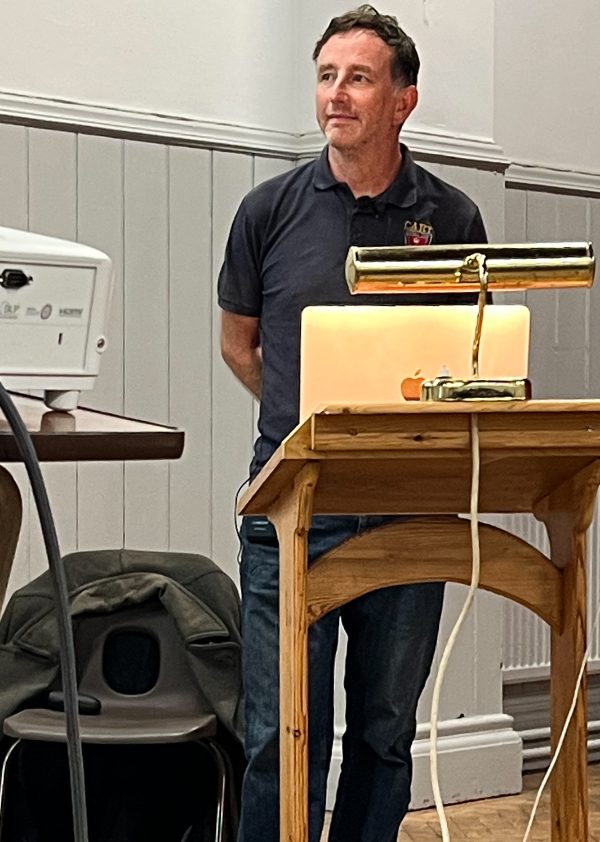
Andrew Chatterton

Reconstruction of an Auxiliary Unit Operational Base at Parham Airfield Museum of the British Resistance Organisation
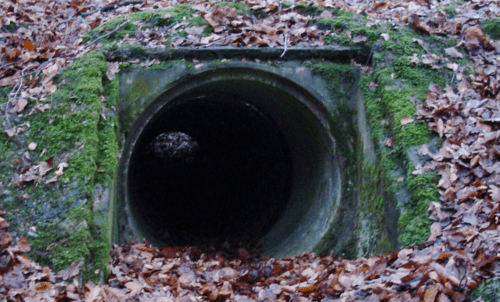
An escape tunnel exit. These would normally have been hidden by brush.
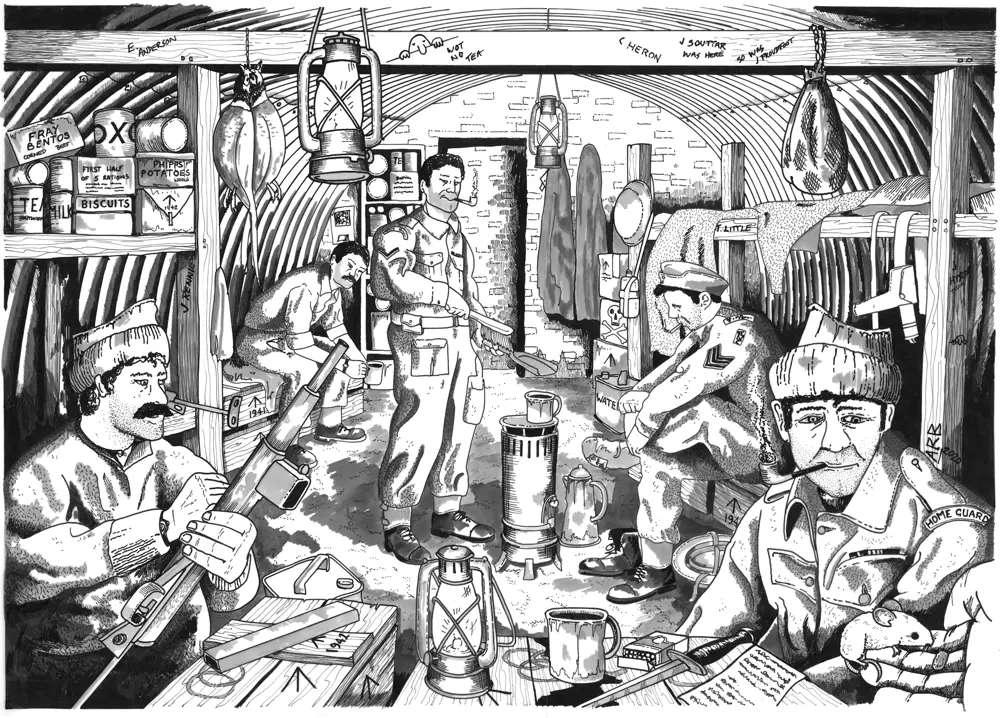
Alam Braby's imagination of an Operational Unit in hiding following an invasion and awaiting orders to emerge for harassment and sabotage – and probable death.